
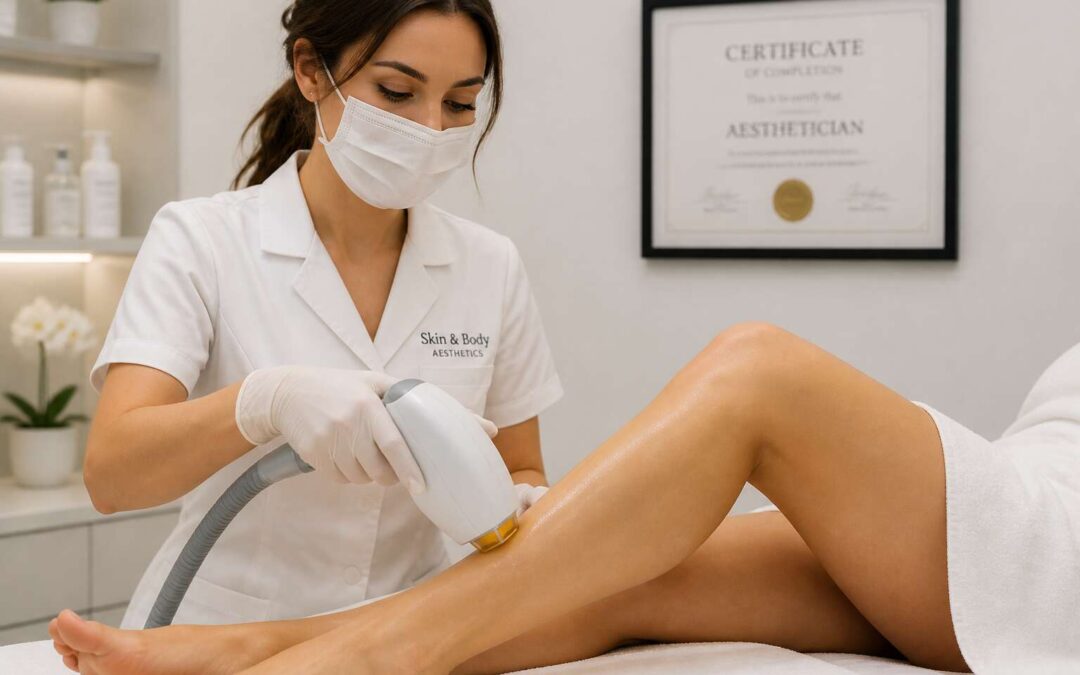
Why Credentials Matter in Laser Hair Removal
Risks of Untrained Practitioners
One misplaced laser pulse can leave a permanent burn or patch of depigmented skin. I have seen clients arrive with second-degree burns from a side street clinic. That is the price of neglecting to verify a practitioner’s background. In South Africa, the line between aesthetic therapy and medical practice often blurs, and that blur creates danger.
Untrained operators frequently set fluence too high, miss the correct chromophore, or skip the mandatory skin type screening. The consequences are concrete: hyperpigmentation, scarring, or even paradoxical hair growth. Consider the common failures:
- Cooling systems are misaligned, causing epidermal burns.
- Patch tests are omitted, leading to allergic responses.
- Sanitisation protocols are ignored, raising infection risk.
Verifying proper laser hair removal qualifications is not a bureaucratic hurdle. It is the only barrier between you and a preventable injury. A qualified professional can explain melanin absorption, contraindications for photosensitising medications, and cooling dynamics. That explanation is the credential in action.
Medical vs. Aesthetic Settings
In South Africa, the distinction between medical and aesthetic settings often dictates the depth of laser hair removal qualifications required. A medical doctor holds a qualification that includes dermatological diagnosis, while an aesthetic therapist may hold only a short course certificate. That gap matters because the laser interacts with living tissue. The setting influences how complications are managed, how equipment is calibrated, and what aftercare is provided.
Consider what a verified credential should confirm:
- Familiarity with the Fitzpatrick skin type scale and its application to the diverse skin tones common in South Africa.
- Understanding of photosensitising medications and their effect on the skin’s response to light.
- Competence in managing adverse events without immediately referring you to a distant emergency room.
A verified laser hair removal qualification distinguishes a treatment from a clinical intervention. Whether you choose a medical spa or a standalone clinic, that credential remains your primary safeguard.
Legal Liability for Clients
When a laser session goes wrong, the legal burden often settles on the client. South African courts expect practitioners to hold demonstrable laser hair removal qualifications before operating light-based devices. Without those credentials, your compensation claim weakens considerably.
Consider what a verified qualification provides:
- A documented standard of care that establishes negligence when breached
- Proof of training in skin typing and device calibration
- A clear chain of accountability for adverse events
The absence of verifiable credentials shifts that liability to you. You prove the practitioner failed. You source independent medical reports. You carry the cost. Clients with documented credentials hold the stronger position.
How Credentials Affect Treatment Outcomes
In South Africa, the difference between a smooth result and a permanent scar often rests on one factor: verified laser hair removal qualifications. The treatment room feels clinical, but the outcome is not guaranteed!
Credentials translate directly into treatment outcomes. A qualified practitioner reads your Fitzpatrick skin type, adjusts fluence and pulse duration, and selects the correct wavelength for your melanin density. Without this training, the same operator produces unpredictable results.
- Proper cooling protocols prevent thermal injury
- Patch testing identifies adverse reactions before full treatment
- Device maintenance follows manufacturer specifications
Each factor alters the final result. The unqualified operator may achieve short term hair loss, but at the cost of hyperpigmentation, blistering, or paradoxical growth. Verified laser hair removal qualifications turn a routine session into a calculated procedure. That makes proof essential.
Essential Certifications and Licenses
State Licensing Requirements
In South Africa, owning a laser machine is easy. Legally operating one for hair removal is a different matter. The HPCSA requires practitioners to hold formal laser hair removal qualifications, typically a certificate from an accredited training provider, before they can work without direct medical supervision.
Here’s what you need to know to remain legitimate:
- A relevant beauty therapy or nursing diploma
- A registered laser safety officer course
- Proof of practical hours under a qualified clinician
Provincial health departments also inspect your premises for compliance with statutory radiation safety standards. These checks verify your laser hair removal qualifications are current and match the equipment you operate. Skipping these certifications leaves you exposed to fines or a permanent ban from the industry. I have seen estheticians lose their livelihoods over one missing document, so keep your compliance folder updated and accessible.
Approved Training Programs
The most persuasive credential in this industry is a certificate that has been earned, not merely printed. Approved training programs in South Africa are fewer than you think, and that scarcity is a feature! I have seen curricula that look rigorous until the fine print reveals optional practical hours.
- Device-specific physics and skin interaction
- Supervised clinical hours with real patients
- A formal assessment of complications management
Accreditation from the Health and Welfare Sector Education and Training Authority or an equivalent body carries real weight. The HPCSA will not be charmed by enthusiasm. Your laser hair removal qualifications must trace back to a curriculum that meets national standards. The best providers will volunteer their pass rates and audit records without prompting. A polished website cannot replace verifiable laser hair removal qualifications. The machine is not the skill. The certificate is only the beginning of the conversation.
Certifying Bodies to Recognize
Certifications without a recognised issuer are merely paper. In South Africa, the authoritative names are few, and that precision matters. The Health Professions Council of South Africa (HPCSA) remains the primary regulator, while the South African Association of Health and Skin Professionals (SAAHSP) provides voluntary accreditation that signals serious adherence to safety protocols. I always probe for these credentials first.
Consider the range of valid markers:
- HPCSA registration for medical oversight
- SAAHSP accreditation for technical competence
- A valid certificate from an approved laser safety officer course
These markers distinguish robust laser hair removal qualifications from decorative ones. When a practitioner names their issuing body without hesitation, you know the qualification has survived scrutiny. The licence number also deserves verification. A regulation that lacks a number shares no accountability. Trust the paper only when the authority behind it can be traced, and your laser hair removal qualifications become something you can actually verify!
Scope of Practice by Profession
Each profession in South Africa holds a distinct scope of practice. A dermatologist may perform treatments without direct supervision, but a registered nurse cannot deviate from prescribed protocols. An aesthetician operates under even tighter limits.
Essential licences break down by role:
- Medical doctor: HPCSA registration and advanced laser safety certification.
- Registered nurse: valid laser training plus a supervising physician’s sign-off.
- Aesthetician: SAAHSP accreditation and a certified safety course.
I always compare the licence number to the claimed profession. Scope violations often occur despite impressive certificates. Genuine laser hair removal qualifications require the right paperwork for the right job!
Continuing Education Obligations
Continuing education is where many practitioners stumble. I have witnessed clinicians let their laser hair removal qualifications lapse simply because they underestimated the refresh cycles! In South Africa, the HPCSA and SAAHSP mandate specific CPD points every two years, but the real nuance lies in the practical assessments.
- Annual laser safety refresher courses
- Hands on machine updates for new wavelengths
- Documented supervision hours for aestheticians
Without these, your certification becomes a static document. The regulatory bodies expect proof of ongoing competency, not merely a framed certificate. Treat every training session as a chance to refine your techniques, because your professional standing depends on it.
What to Ask Before Booking a Treatment
Questions About the Operator’s Experience
Before you lie down on that treatment bed, ask yourself one question: how many faces, legs, and arms has this operator actually touched? A machine can be flawless, but the hands guiding it carry the real authority. In South Africa, where skin tones and hair textures vary widely, experience becomes the quiet difference between a smooth result and a regret.
Ask how many sessions they have personally performed in the past year. Ask whether they have treated skin like yours, and how they adjusted the settings. Enquire about complications they have faced and what they learned.
- How long have you used this specific laser device?
- What portion of your clients share my skin type and hair colour?
- Can you walk me through a difficult treatment you handled?
Their answers reveal more than any certificate on the wall. A confident operator welcomes your questions. Hesitation may signal gaps in their laser hair removal qualifications.
Verifying Certification Credentials
Certification papers can look impressive, but a quick phone call does more. Before you book, ask the clinic for the full name of the certifying body printed on the operator’s certificate. Verify directly. In South Africa, legitimate laser hair removal qualifications come from registered training providers, not weekend workshops. Ask to see the practical assessment record, not the attendance certificate. A practitioner who refuses to share this paperwork should make you reconsider. I always verify this before booking.
The following details should be available:
- The exact laser hair removal qualifications held by the person treating you.
- The date of issue and expiry of those credentials.
- The name and contact details of the issuing institution.
Check whether the certificate lists the specific laser device you will receive treatment on. Many practitioners hold generic laser safety certificates but lack device-specific training. That distinction matters more than the certificate’s display.
Assessing the Equipment and Facility
Before you commit to a session, confirm the operator’s laser hair removal qualifications, then walk the treatment room. The machine itself should be identifiable, with a visible model number and a serial tag that matches the calibration record. Ask for the device’s service history. A laser that has not been maintained in accordance with the manufacturer’s schedule will deliver inconsistent energy, and that inconsistency can scar as easily as it can remove hair.
Your laser hair removal qualifications are only as meaningful as the instrument they are applied to. Request a patch test on a small area. The practitioner should adjust fluence based on your skin type, and the facility should have a chilled tip mechanism or a cooling gel. If the room lacks a fire extinguisher, an eyewash station, or a clearly marked emergency shutoff for the laser, walk away.
- Ask for the last three maintenance logs.
- Confirm the device’s wavelength is suitable for your skin tone.
- Check that the operator can name the spot size and pulse duration they plan to use.
Red Flags and Warning Signs
Unwillingness to Provide Documentation
In the beauty industry, silence is rarely golden. When you ask to see the paperwork behind your technician’s laser hair removal qualifications and the room goes quiet, that quiet is your answer.
Documentation is the mundane proof of competence. A legitimate practitioner will happily show you their certificates, their insurance, and their registration numbers. The one who deflects, changes the subject, or claims the documents are at another branch is offering you a valuable warning. Their laser hair removal qualifications exist only in their own telling, which is precisely why they avoid the paper trail.
Watch for these telltale refusals:
- The request for a copy of their certification meets a vague delay.
- The clinic’s name on the certificate does not match the one above the door.
- A staff member insists that the files are purely administrative.
Every excuse is a clue. In South Africa, proper laser hair removal qualifications are verifiable, public, and utterly boring. If they cannot produce them on the spot, they are betting on your politeness. Do not let that bet pay off.
Lack of Consultation or Patch Test
Some clinics move straight to the laser. They ask no questions about your skin, your medication, or your healing patterns. This is a red flag that should pause the appointment. A legitimate practitioner knows that laser hair removal qualifications begin with a consultation, not with the handpiece.
A patch test is the other missing piece. It takes a few minutes and shows how your skin responds to the specific wavelength. Without it, you are the first test subject, and that is an unnecessary risk.
Watch for these signs in your first visit:
- No questions about your medical history
- No offer of a patch test before the first session
- No discussion of your recent sun exposure
Each omission is a quiet admission that the clinic follows its own convenience, not your safety.
Pressure to Sign Contracts Immediately
Some clinics treat the consent form like a gate. They push it toward you with a pen and a scripted pitch, then talk over your hesitation. That pressure is information. A trustworthy practice lets you read, ask questions, and return. Genuine laser hair removal qualifications include patient education, not coercion. If the offer evaporates when you request a day to think, that is the answer.
Watch for these warning signs:
- A non-refundable package price only available for today
- A “loyalty” discount that disappears if you consult elsewhere
- Fine print that waives the clinic’s responsibility for poor results
An operator with real laser hair removal qualifications does not rely on urgency. The procedure is elective. They trust their work enough to let it stand on its own. If a signature is demand, not a choice, walk away.
Inappropriately Low Pricing
A lower-leg laser session typically costs between R250 and R600 in South African clinics. When a clinic advertises the same treatment for R99, that gap is not a bargain. It is a warning about the equipment, the operator, or the laser hair removal qualifications behind the counter.
Cheap pricing often means renting time on an IPL device that is not actually a laser. A qualified practitioner will explain why their price sits within a certain range and discuss wavelength, cooling, and session counts. An unqualified operator will simply quote a number and hand you the gown.
- A price half the local average
- A prepaid package requiring six sessions upfront
- A rate that never adjusts for different body areas
The true cost of a cheap laser session appears months later as hyperpigmentation, burns, or thicker hair. I have seen clients carry those marks for years. Genuine laser hair removal qualifications are not negotiable. Neither is the safety of your epidermis.
Poor Hygiene and Safety Protocols
The treatment room itself should tell you a story before the laser ever touches your skin. If the bed is not covered with fresh paper or linens, if handpieces sit openly on counters, or if the technician handles them without gloves, you are seeing a facility that does not respect infection control. I have walked into clinics where the same spatula dipped into a jar of gel for every client, and I walked right back out. Hygiene protocols are not aesthetic preferences. They are clinical requirements.
Observe the details:
- Are the treatment goggles sealed and sanitized between clients?
- Does the practitioner wash or sanitize their hands in front of you?
- Is the laser handpiece wiped with an approved disinfectant before the session?
A practitioner with genuine laser hair removal qualifications will not rush this routine. They know that cross contamination risks are real and that their professional reputation depends on visible rigor. If the environment feels chaotic or the safety steps feel optional, that is your cue to leave. Your skin deserves more than a discount gamble.
Negative Reviews or Complaints
Negative reviews rarely lie. When potential clients search for laser hair removal qualifications, they often read ten glowing testimonials and one scathing complaint. That single complaint usually reveals more than the ten. I have read reviews describing burns, hyperpigmentation, and technicians who could not answer basic questions. The pattern repeats across months. The clinic responds with defensiveness or silence. Neither is acceptable.
Watch for how a business handles criticism. A practitioner with genuine laser hair removal qualifications will acknowledge errors, explain corrective measures, and demonstrate what changed. A clinic that suppresses negative feedback or manufactures praise is hiding something structural.
In South Africa, community review platforms matter. Complaints that mention the same practitioner across different accounts point to a pattern of behavior. Repeated complaints about the same issue demand attention. One bad day happens. A trajectory of complaints does not. The aggregate tells the truth. The apology does not.
How to Verify a Practitioner’s Qualifications
Checking State Regulatory Boards
Verifying a practitioner’s credentials demands more than a glance at a framed certificate. In South Africa, the regulatory boards that govern laser hair removal vary by province, so the first step is identifying which body oversees your area. The HPCSA registers certain health practitioners, while some aesthetic professionals fall under allied health professions councils.
I always advise clients to consult the relevant board’s online register or contact their office directly. A legitimate practitioner will expect this scrutiny and provide their registration number without hesitation. Ask them to confirm:
– Their registration status with the appropriate council
– Any restrictions or conditions on their license
– Whether their laser hair removal qualifications match their registered scope
A board that cannot confirm a practitioner’s standing raises the same red flags as a practitioner who refuses to show documentation.
Contacting Professional Associations
Professional associations offer a quieter layer of verification. Bodies like the South African Medical Aesthetics Practitioners Association keep their own registers of members who meet ongoing standards. A practitioner who belongs to such an association has submitted to peer review and ethics protocols beyond the legal minimum.
Ask which associations they belong to, then reach out directly. Confirm their membership status and any disciplinary history. These organisations often require documented laser hair removal qualifications before granting membership, making them a useful filter.
- Check if the association has a public member directory
- Ask if membership requires annual proof of competency
- Confirm whether the association handles complaints
Membership in a credible association does not replace state registration, but it does provide another reason to trust the practitioner’s claims.
Requesting Before-and-After Photos
Before-and-after photos reveal a practitioner’s practical history. A single image can betray years of careful training or expose a pattern of careless work. Request images from the last twelve months, not the glossy portfolio from their training day! Look for consistent lighting and camera settings, because those factors influence the outcome.
Scrutinise the skin tones and hair types represented. A practitioner who only showcases pale skin or fine hair has not proven their ability to manage diverse clients. Ask for photos that match your own profile. The following signs separate genuine results from curated marketing:
- Same angle and distance in every pair
- Unedited texture, including visible pores or redness
- Dates stamped on the original files
Honest practitioners share these freely. Their laser hair removal qualifications become evident through a transparent record. Demand the same standard before you commit, because a portfolio without traceable proof tells you nothing.
Reading Client Testimonials
Client testimonials often reveal more than a studio’s comfort. They expose patterns. When someone describes their experience, notice if they mention the practitioner’s laser hair removal qualifications or only the temperature of the room. A testimonial naming the specific machine, the aftercare advice, and the technician’s response to questions carries more weight than a generic five-star rating.
I look for testimonials from clients with similar skin tones and hair types. South Africa’s diverse population means results vary widely. A glowing review from someone with light skin may not predict your outcome.
- Search for practitioner responses to negative reviews
- Notice if answers offer medical detail or vague reassurance
- Check whether repeat clients mention consistent results
Patterns in testimonials, not individual praise, indicate genuine competence. The quiet mentions of laser hair removal qualifications in a client’s story often signal the most honest assessment.